
Learn More
Retatrutide Dosage Guide: Step by Step Instructions and Full Dosage Chart
Jul
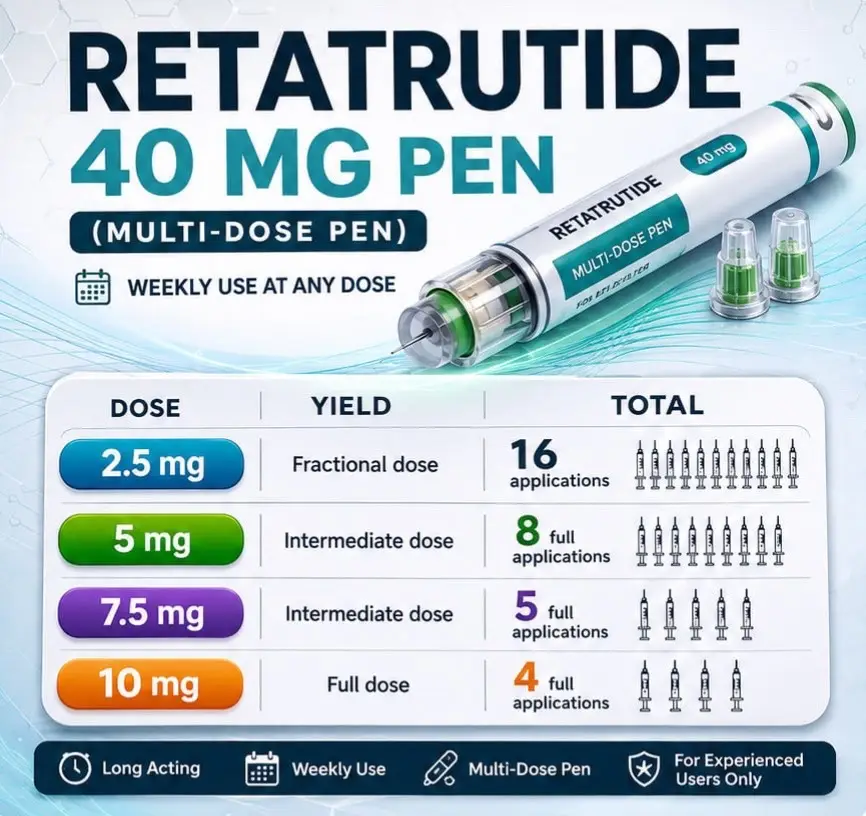
Retatrutide Dosing Schedule Overview
Retatrutide (reta) is a triple agonist targeting GLP-1, GIP, and glucagon receptors. Phase 2 trials showed up to 24.2% weight loss at 48 weeks, more than any other GLP-1 class medication tested so far. The dosing protocol matters because titrating too fast is the main cause of intolerable side effects.
The standard retatrutide dosing protocol follows a gradual titration approach, similar to other GLP-1 agonists like semaglutide and tirzepatide. This slow increase allows your body to adapt to the medication and helps manage common gastrointestinal side effects.
| Phase | Weeks | Weekly Dose | Purpose |
|---|---|---|---|
| Initial | 1-4 | 2mg | Assess tolerance, minimize GI effects |
| Escalation 1 | 5-8 | 4mg | Begin therapeutic effect |
| Escalation 2 | 9-12 | 8mg | Full therapeutic range |
| Maximum | 13+ | 12mg | Maximum studied dose |
Understanding Retatrutide: Mechanism and Pharmacology
What it is: Retatrutide (LY3437943) is an injectable that activates three metabolic receptors: GLP-1, GIP, and glucagon. Semaglutide targets only GLP-1; tirzepatide targets GLP-1 and GIP. The added glucagon receptor activation increases energy expenditure and fat burning.
Triple-Agonist Mechanism of Action
GLP-1 Pathway (Glucagon-Like Peptide-1)
Activates receptors in the hypothalamus to reduce appetite, stimulates insulin secretion from pancreatic beta cells, and slows gastric emptying. This is the same pathway semaglutide and tirzepatide use. It’s the core appetite suppression mechanism.
GIP Pathway (Glucose-Dependent Insulinotropic Polypeptide)
Improves insulin sensitivity and may promote more favorable fat distribution. GIP receptors in adipose tissue appear to reduce inflammation. Tirzepatide’s dual GLP-1/GIP action outperformed GLP-1-only drugs like semaglutide, suggesting GIP adds real value beyond just GLP-1.
Glucagon Pathway
Increases energy expenditure through thermogenesis and promotes lipolysis (fat breakdown). Glucagon also stimulates hepatic glucose output in the fasted state, which drives fat oxidation. This third mechanism is what separates retatrutide from tirzepatide and likely explains the additional ~2% weight loss seen in trials.
The net result: reduced appetite (GLP-1), improved insulin action and fat metabolism (GIP), plus increased energy expenditure (glucagon). Phase 2 data showed up to 24.2% weight loss at 48 weeks with the 12mg dose. Each additional receptor target has produced incrementally better outcomes in clinical trials.

Starting Dose for Retatrutide
The recommended retatrutide starting dose is 2mg once weekly. This dose won’t produce significant weight loss on its own. It’s there to let your body adjust before moving to therapeutic doses.
Why Start at 2mg?
- GI adaptation: Lower doses allow the digestive system to adjust, reducing nausea and vomiting
- Triple receptor activation: Retatrutide’s unique GLP-1/GIP/glucagon mechanism requires gradual introduction
- Safety monitoring: Assess individual response before increasing to therapeutic doses
- Injection site tolerance: Verify no local reactions before committing to higher doses
What to Expect in the First Week
During the initial retatrutide dose, you may experience:
- Mild appetite reduction (typically noticeable by days 2-3)
- Possible nausea, especially with large or fatty meals
- Minor injection site reaction (redness, mild swelling)
- Increased satiety after smaller portions
Retatrutide Titration Schedule
The retatrutide titration schedule follows a 4-week escalation pattern. For a quick visual reference, download our printable retatrutide dosage chart. Each dose increase should only occur if the current dose is well-tolerated.
Week-by-Week Breakdown
Weeks 1-4: 2mg/week
Focus on establishing routine. Take your injection on the same day each week. Monitor for side effects and note your appetite changes. Minimal weight loss expected (0-2 lbs).
Weeks 5-8: 4mg/week
First therapeutic dose. Appetite suppression becomes more noticeable. Weight loss typically begins (2-5 lbs expected). GI side effects may briefly intensify then stabilize.
Weeks 9-12: 8mg/week
Full therapeutic range. Significant appetite suppression and weight loss. Many users find this dose sufficient and may not need to increase further. Expected loss: 4-8 lbs.
Week 13+: 12mg/week (if needed)
Maximum dose for those who plateau at 8mg. Not all users require this dose. Consider staying at 8mg if weight loss is satisfactory and side effects are manageable.
For the complete titration schedule with detailed timing, see our full retatrutide protocol.
When to Delay Dose Escalation
Hold your current retatrutide dose and don’t escalate if you experience:
- Persistent nausea or vomiting (more than 3 days after injection)
- Severe constipation or diarrhea
- Significant injection site reactions
- Rapid weight loss (more than 3-4 lbs/week consistently)
- Signs of dehydration from GI symptoms
It’s acceptable to remain at a dose longer than 4 weeks if needed. Some users stay at 4mg or 8mg for 6-8 weeks before escalating. The titration schedule is a guideline, not a requirement.
Conservative Titration (Community Approach)
Some community members prefer an even more gradual approach, starting at 1mg weekly before moving to the trial-based 2mg starting dose. This can be helpful for:
- Individuals with a history of GI sensitivity
- Those who experienced significant side effects with other GLP-1 medications
- People who prefer the most cautious approach possible
| Weeks | Weekly Dose | Notes |
|---|---|---|
| 1-4 | 1mg | Ultra-conservative start (not in trials) |
| 5-8 | 2mg | Trial starting dose |
| 9-12 | 4mg | First therapeutic dose |
| 13-16 | 6-8mg | Full therapeutic range |
| 17+ | 8-12mg | Maintenance (if needed) |
Note: The 1mg starting dose is a community preference, not a clinical trial protocol.
Microdosing Retatrutide: Alternative Approach
Some users explore microdosing retatrutide, splitting the weekly dose into multiple smaller injections. This approach aims to reduce side effects by maintaining more stable drug levels.
Common Microdosing Protocols
| Protocol | Example (8mg total) | Peak Reduction |
|---|---|---|
| Twice weekly | 4mg Mon + 4mg Thu | ~28% |
| Three times weekly | 2.7mg Mon/Wed/Fri | ~35% |
| Daily | 1.15mg daily | ~48% |
Important: Retatrutide itself is not FDA-approved (expected 2027). Microdosing protocols have not been studied in clinical trials. All evidence is theoretical or anecdotal. Consult your healthcare provider before modifying your dosing schedule.
Read our microdosing retatrutide guide for detailed protocols, benefits, risks, and pharmacokinetic modeling.
Retatrutide Half-Life and Steady State
Understanding retatrutide’s pharmacokinetics helps explain why the dosing schedule is structured as it is.
Half-Life: ~6 Days
Retatrutide has a terminal half-life of approximately 6 days, meaning half of the drug is eliminated from your body every 6 days. This extended half-life allows for once-weekly dosing and explains why effects persist even if you miss a dose.
Half-life, in plain language: If you inject 5 mg on day 0, about 2.5 mg remains ~6 days later, and ~1.25 mg after ~12 days. Because levels fall slowly, once-weekly dosing works well.
| Compound | Mechanism | Half-Life | Time to Steady State | Max Weight Loss (Trial Data) | Source |
|---|---|---|---|---|---|
| Retatrutide | Triple: GLP-1/GIP/Glucagon | ~6 days | ~4–5 weeks | -24.2% at 48 weeks | NEJM 2023 |
| Tirzepatide | Dual: GLP-1/GIP | ~5 days | ~4 weeks | -20.9% at 72 weeks | NEJM 2022 |
| Semaglutide | Single: GLP-1 | ~7 days | ~4–5 weeks | -14.9% at 68 weeks | NEJM 2021 |
Trial data comparison shows the progression from single-agonist (semaglutide) to dual-agonist (tirzepatide) to triple-agonist (retatrutide) correlates with increasing weight loss efficacy. Note that trial durations differ and head-to-head comparisons are not yet available.

Half-life comparison: Retatrutide (~6 days) vs Tirzepatide (~5 days) vs Semaglutide (~7 days)
Steady State: 4-5 Weeks
Why steady state matters: Most drugs reach steady state after ~4–5 half-lives, which for retatrutide is about 4–5 weeks of weekly injections. That’s when peaks and troughs stop rising and therapeutic effects become consistent. Understanding this pharmacokinetic principle helps set realistic expectations for symptom improvement.
What this means for you: Don’t judge a dose’s effectiveness until you’ve been on it for at least 4 weeks. Early weeks may have more variation; stability comes with time.

Weekly vs microdosing: Note the smoother levels with split dosing (lower peaks, higher troughs)
Our retatrutide calculator can model your specific protocol and show when you’ll reach steady state at each dose level.
Using a Retatrutide Dosing Calculator
A dosing calculator helps you visualize how retatrutide builds up in your system over time and what to expect at different doses and frequencies.
What GLP3 Planner Can Help You Understand
- Drug concentration curves: See how levels rise and fall between injections
- Steady state timing: Know when to expect stable drug levels
- Dose comparison: Compare different titration schedules side-by-side
- Microdosing modeling: Visualize split-dose protocols
- Shareable schedules: Create URLs to discuss your protocol with providers
Plan Your Retatrutide Protocol
Use our free calculator to model your retatrutide dosing schedule with pharmacokinetic projections.
Plotter Units Calculator Cost Calculator
Retatrutide vs Other GLP-1 Dosing
How does retatrutide dosing compare to other popular GLP-1 agonists? Here’s a quick comparison:
| Medication | Starting Dose | Max Dose | Titration |
|---|---|---|---|
| Retatrutide | 2mg/week | 12mg/week | 4-week intervals |
| Semaglutide (Wegovy) | 0.25mg/week | 2.4mg/week | 4-week intervals |
| Tirzepatide (Mounjaro) | 2.5mg/week | 15mg/week | 4-week intervals |
While dosing schedules appear similar, retatrutide’s triple-receptor mechanism (GLP-1 + GIP + glucagon) produces different effects than dual-agonists like tirzepatide or single-agonists like semaglutide.
Looking for alternatives? See our comparison guides:
- GLP-1 Plotter Alternatives – Compare free dose calculators
- Shotsy Alternatives – Free tracking app options
- Glapp Alternatives – GLP-1 app comparison
